
By Yash Patel, Founder, Kevion Technologies
Jewellery Making Charges and Wastage Calculation Guide
A practical guide for Indian jewellers on calculating making charges and wastage, and how to automate daily price updates.
Pricing jewellery is a demanding daily task for retail store owners in India. Every morning, the gold or silver rate changes. This forces you to recalculate the selling price of every single piece in your showroom. Doing this manually or using static spreadsheets is slow and prone to costly errors.
Understanding how making charges and wastage are calculated is the first step toward accurate pricing. We build systems like Jewellery ERP to automate this entire process. In this article, we explain the mechanics of these calculations and how to manage them without manual errors.
What a making charge covers
A making charge represents the cost of turning raw metal into a finished piece of jewellery. This charge covers the labour of the artisans, the use of specialized machinery, and the operational costs of the workshop.
Typically, making charges vary based on the complexity of the design. A simple gold chain requires less effort and has a lower making charge. A highly detailed temple necklace or an antique piece requires skilled craftsmanship, which increases the cost.
Three ways jewellers charge for making
Indian jewellers typically calculate making charges in one of three ways:
- Per Gram: You charge a fixed rupee amount for every gram of net metal weight. For example, if the making charge is Rs 500 per gram and the piece weighs 10 grams, the total making charge is Rs 5,000.
- Percentage of Metal Value: The making charge is calculated as a percentage of the metal's value on that day. If the gold value is Rs 1,00,000 and the making charge is 12%, the customer pays Rs 12,000 for making.
- Fixed Amount: You apply a flat rupee charge for the entire piece, regardless of its weight or the daily metal rate. This is common for highly standardized items or intricate designer pieces.
Managing these three options across hundreds of SKUs is difficult. In our custom software development work, we ensure that pricing engines can handle all three calculation methods simultaneously.
What wastage means and why it varies
During the jewellery-making process, some metal is lost. This loss happens during melting, cutting, soldering, and polishing. Jewellers call this lost metal wastage or vaida.
Wastage is calculated as a percentage of the net metal weight. Typically, handmade jewellery has a higher wastage percentage than machine-made jewellery. Intricate designs require more cutting and polishing, which leads to more lost metal.
To recover this cost, you must add the wastage percentage to the metal value. For example, if a piece has a net weight of 10 grams and a wastage of 4%, you calculate the metal cost based on 10.4 grams.
A worked example
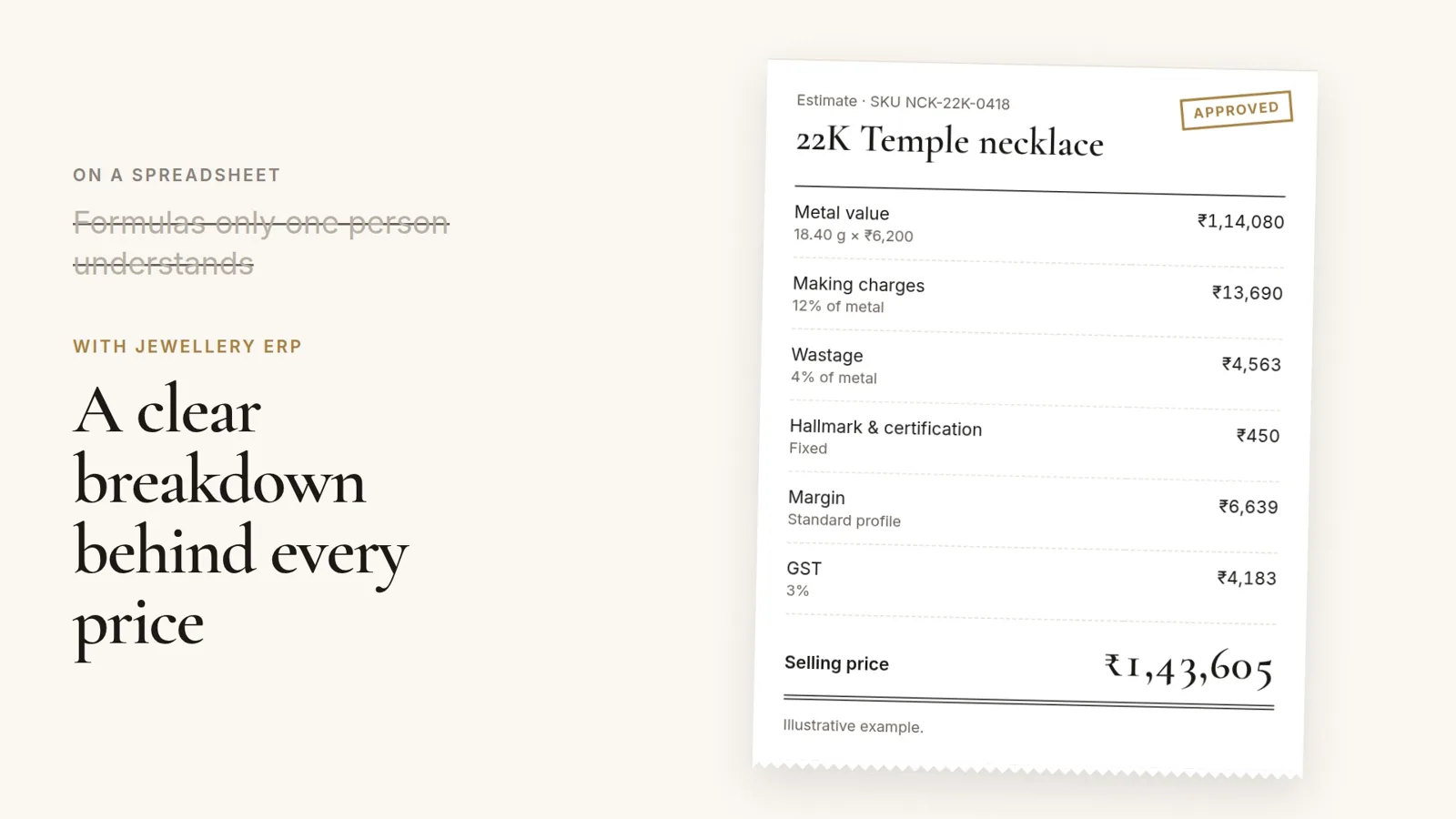
Let us look at a practical example of how these components come together to form the final selling price. This is an illustrative example taken from the product's own material.
Imagine a 22K temple necklace with a net weight of 18.40 grams. The daily gold rate for 22K gold is Rs 6,200 per gram.
- Metal Value: 18.40 grams multiplied by Rs 6,200 equals Rs 1,14,080.
- Making Charges: 12% of the metal value equals Rs 13,690.
- Wastage: 4% of the metal value equals Rs 4,563.
- Fixed Charges: Hallmark and certification cost is Rs 450.
- Margin: Business margin of Rs 6,639.
- GST: 3% of the subtotal equals Rs 4,183.
- Selling Price: The final price is Rs 1,43,605.
Where spreadsheets go wrong
Many jewellers manage these calculations using Microsoft Excel or Google Sheets. While spreadsheets are better than paper, they fail when your inventory grows or when you sell online.
First, spreadsheets do not update automatically when the gold rate changes. You must manually open the file, update the daily rate, and copy the formulas down hundreds of rows. One wrong keystroke can ruin your profit margins or result in overpriced items that do not sell.
Second, spreadsheets do not sync with your e-commerce store. If you run a Shopify store, you must manually upload the new prices every day. To solve this, we built Jewellery ERP, our own pricing software for jewellers.
With Jewellery ERP, you record each piece's purity, net weight, making charge, wastage, stones, and fixed charges. When you enter the day's metal rate, every SKU is priced again instantly with a line-by-line breakdown. You can then send these updated prices directly to Shopify using our Shopify app development integrations. Read more about what to look for in our guide on jewellery ERP software.
The software is live with a free plan at jewellery-erp.keviontechnologies.in.
If you want to move away from manual calculations and build a reliable pricing system, we can help. Contact Yash Patel and our engineering team at contact. We promise to reply within one business day.
Frequently Asked Questions
What is the difference between making charges and wastage?
Making charges cover the labour and operational costs of turning raw metal into jewellery, which can be a percentage, a flat fee, or a per-gram rate. Wastage is a percentage that accounts for the metal lost during melting, cutting, and polishing.
How does Jewellery ERP handle daily gold rate fluctuations?
When you enter the daily metal rate in Jewellery ERP, the software automatically recalculates the price of every SKU instantly, providing a line-by-line breakdown of metal value, making charges, wastage, and taxes.
Can I sync my calculated jewellery prices with my online store?
Yes, Jewellery ERP allows you to send your updated, rate-driven prices directly to Shopify.
Is there a free version of Jewellery ERP available?
Yes, Jewellery ERP is live with a free plan that you can access at jewellery-erp.keviontechnologies.in.
Have a project in mind?
Shopify, Magento, Laravel or AI: we go deep, not wide. Get a free consultation with a senior engineer.
Get a Free ConsultationCustom Software Development
SaaS products, internal tools, CRMs, customer portals and marketplaces, built around how your business works. Laravel, Node.js and Next.js, with the code handed over to you.
How we can help →API Performance Optimization: Logistics Platform
- Problem
- Slow APIs and database bottlenecks delayed shipment tracking and dashboards at peak traffic, while cloud costs kept rising.
- What we did
- Backend and database overhaul for a logistics platform processing thousands of shipment updates daily: faster APIs, Redis caching, and a cloud-ready architecture.
More articles
PHP2Shell (CVE-2026-109618, CVE-2026-109619): Patch Every PHP Server Now
Jewellery ERP Software: What It Must Handle Before You Buy or Build
Laravel SaaS Architecture: A Practical Multi-Tenant Guide
Building Yuvapri Health: A React and Laravel Storefront for a Supplements Brand
Get new articles by email
Practical Magento, Shopify, Laravel & AI guides, about once a month. Unsubscribe anytime.